Template:Featured content/test cases: Difference between revisions
From Transport Knowledge Wiki
Created page with "{{featured content | publication_symbol = {{Webpage symbol}} | title = Delivery Robots | date = 29 June 2026 | summary = "Delivery robots raise significant concerns for pedestrians. By occupying pavement space, they add congestion and clutter to the pavements, increasing competition for pavement space that is already a major issue in the UK – for example micromobility modes, electric vehicle charging points and pavement pa..." |
No edit summary |
||
| (29 intermediate revisions by the same user not shown) | |||
| Line 1: | Line 1: | ||
==Test 1== | |||
{{featured content | |||
| publication_symbol = {{Journal article symbol}} | |||
| title = [[Benefits and harms of DRT in suburban areas]] | |||
| subtitle = Analysis of user motivations, ridership, and side effects of an app-based demand-responsive transit | |||
| date = {{Date link|June 2026}} | |||
| summary = "Since the rebirth of demand-responsive transit (DRT) after 2010 many failed and discontinued initiatives have been observed. The issues range from inadequate technology, ill-defined spatial and temporal conditions, to missing knowledge of user preferences, low ridership, and of course funding, since many trials are ceased once the subsidy is stopped. In this paper, we explore the use and effects of an app-based DRT in a suburban environment based on the data collected from users and non-users of a newly launched service in Austria. The results indicate that the service performs well as a feeder mode for rail transportation with positive user reviews. However, there are concerns about a limited operating area, too short operating hours and low pooling effects (occupancy rates)." | |||
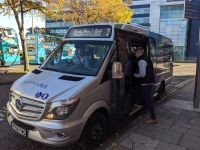
| image = [[File:Demand responsive transport vehicle in Leicester.jpg|200px|link=Benefits and harms of DRT in suburban areas|alt=In a built-up area two men board a small bus with Arriva Click written on it.|right]] | |||
| metadata = {{journal link|Journal of Urban Mobility}} {{author link|Bartosz|Bursa}} {{author link|Nils|Rabeneick}} {{author link|Ferdinand|Ebner}} {{author link|Markus|Mailer}} {{keyword link|Shared mobility}} {{Keyword link|Traffic}} {{location link|Austria}} | |||
}} | |||
{{break}} | |||
{{featured content/sandbox | |||
| publication_symbol = {{Journal article symbol}} | |||
| title = [[Benefits and harms of DRT in suburban areas]] | |||
| subtitle = Analysis of user motivations, ridership, and side effects of an app-based demand-responsive transit | |||
| date = {{Date link|June 2026}} | |||
| summary = "Since the rebirth of demand-responsive transit (DRT) after 2010 many failed and discontinued initiatives have been observed. The issues range from inadequate technology, ill-defined spatial and temporal conditions, to missing knowledge of user preferences, low ridership, and of course funding, since many trials are ceased once the subsidy is stopped. In this paper, we explore the use and effects of an app-based DRT in a suburban environment based on the data collected from users and non-users of a newly launched service in Austria. The results indicate that the service performs well as a feeder mode for rail transportation with positive user reviews. However, there are concerns about a limited operating area, too short operating hours and low pooling effects (occupancy rates)." | |||
| image = [[File:Demand responsive transport vehicle in Leicester.jpg|200px|link=Benefits and harms of DRT in suburban areas|alt=In a built-up area two men board a small bus with Arriva Click written on it.|right]] | |||
| metadata = {{journal link|Journal of Urban Mobility}} {{author link|Bartosz|Bursa}} {{author link|Nils|Rabeneick}} {{author link|Ferdinand|Ebner}} {{author link|Markus|Mailer}} {{keyword link|Shared mobility}} {{Keyword link|Traffic}} {{location link|Austria}} | |||
}} | |||
==Test 2== | |||
{{featured content | {{featured content | ||
| publication_symbol = {{Webpage symbol}} | | publication_symbol = {{Webpage symbol}} | ||
| title = [[Delivery Robots]] | | title = [[Delivery Robots]] | ||
| date = | | subtitle = Delivery robots are small, autonomous vehicles designed to transport parcels. | ||
| date = {{Date link|June 2026|29}} | |||
| summary = "Delivery robots raise significant concerns for pedestrians. By occupying pavement space, they add congestion and clutter to the pavements, increasing competition for pavement space that is already a major issue in the UK – for example micromobility modes, electric vehicle charging points and pavement parking. This disproportionately affects disabled people (particularly wheelchair users and visually impaired people), older pedestrians and adults with prams and pushchairs. There are also unresolved questions about liability when incidents occur, as well as privacy concerns linked to the use of cameras in public space." | | summary = "Delivery robots raise significant concerns for pedestrians. By occupying pavement space, they add congestion and clutter to the pavements, increasing competition for pavement space that is already a major issue in the UK – for example micromobility modes, electric vehicle charging points and pavement parking. This disproportionately affects disabled people (particularly wheelchair users and visually impaired people), older pedestrians and adults with prams and pushchairs. There are also unresolved questions about liability when incidents occur, as well as privacy concerns linked to the use of cameras in public space." | ||
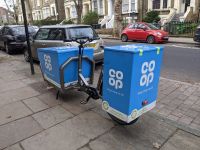
| image = [[File: | | image = [[File:Cargo bike in Islington.jpg|200px|link=Delivery Robots|alt=A cargo bike on a residential street with Co Op whote and blue branding.|right]] | ||
| metadata = {{publisher link|Living Streets}} {{keyword link|Active travel}} {{keyword link|Walking}} {{keyword link|Wheeling}} {{keyword link|Autonomous vehicles}} {{location link|Milton Keynes}} {{location link|Barnsley}} {{location link|Sunderland}} {{location link|Sheffield}} {{location link|Reading}} {{location link|Bristol}} {{location link|Leeds}} {{location link|Cambridge}} {{location link|Pittsburg}} {{location link|Toronto}} {{location link|Chicago}} {{location link|Los Angeles}} | | metadata = {{publisher link|Living Streets}} {{campaign link|Pavement Overload}} {{keyword link|Active travel}} {{keyword link|Walking}} {{keyword link|Wheeling}} {{keyword link|Autonomous vehicles}} {{location link|Milton Keynes}} {{location link|Barnsley}} {{location link|Sunderland}} {{location link|Sheffield}} {{location link|Reading}} {{location link|Bristol}} {{location link|Leeds}} {{location link|Cambridge}} {{location link|Pittsburg}} {{location link|Toronto}} {{location link|Chicago}} {{location link|Los Angeles}} | ||
}} | }} | ||
{{break}} | |||
{{featured content/sandbox | |||
| publication_symbol = {{Webpage symbol}} | |||
| title = [[Delivery Robots]] | |||
| subtitle = Delivery robots are small, autonomous vehicles designed to transport parcels. | |||
| date = {{Date link|June 2026|29}} | |||
| summary = "Delivery robots raise significant concerns for pedestrians. By occupying pavement space, they add congestion and clutter to the pavements, increasing competition for pavement space that is already a major issue in the UK – for example micromobility modes, electric vehicle charging points and pavement parking. This disproportionately affects disabled people (particularly wheelchair users and visually impaired people), older pedestrians and adults with prams and pushchairs. There are also unresolved questions about liability when incidents occur, as well as privacy concerns linked to the use of cameras in public space." | |||
| image = [[File:Cargo bike in Islington.jpg|200px|link=Delivery Robots|alt=A cargo bike on a residential street with Co Op whote and blue branding.|right]] | |||
| metadata = {{publisher link|Living Streets}} {{campaign link|Pavement Overload}} {{keyword link|Active travel}} {{keyword link|Walking}} {{keyword link|Wheeling}} {{keyword link|Autonomous vehicles}} {{location link|Milton Keynes}} {{location link|Barnsley}} {{location link|Sunderland}} {{location link|Sheffield}} {{location link|Reading}} {{location link|Bristol}} {{location link|Leeds}} {{location link|Cambridge}} {{location link|Pittsburg}} {{location link|Toronto}} {{location link|Chicago}} {{location link|Los Angeles}} | |||
}}<noinclude>[[Category:Templates test cases]]</noinclude> | |||
Latest revision as of 06:03, 11 July 2026
Test 1
 Benefits and harms of DRT in suburban areas Benefits and harms of DRT in suburban areas
|
 June 2026 June 2026
|
| Analysis of user motivations, ridership, and side effects of an app-based demand-responsive transit | |
 | |
 Journal of Urban Mobility (1) Journal of Urban Mobility (1)  Bartosz Bursa (1) Nils Rabeneick (1) Ferdinand Ebner (1) Markus Mailer (1) Bartosz Bursa (1) Nils Rabeneick (1) Ferdinand Ebner (1) Markus Mailer (1)  Shared mobility (2) Traffic (44) Shared mobility (2) Traffic (44)  Austria (2) Austria (2)
| |
| Benefits and harms of DRT in suburban areas
|
June 2026
|
| Analysis of user motivations, ridership, and side effects of an app-based demand-responsive transit | |
| |
| Journal of Urban Mobility (1) Bartosz Bursa (1) Nils Rabeneick (1) Ferdinand Ebner (1) Markus Mailer (1) Shared mobility (2) Traffic (44) Austria (2)
| |
Test 2
 Delivery Robots Delivery Robots
|
29 June 2026
|
| Delivery robots are small, autonomous vehicles designed to transport parcels. | |
 | |
 Living Streets (8) Living Streets (8)  Pavement Overload (2) Active travel (90) Walking (86) Wheeling (40) Autonomous vehicles (4) Milton Keynes (1) Barnsley (1) Sunderland (1) Sheffield (5) Reading (1) Bristol (6) Leeds (9) Cambridge (4) Pittsburg (1) Toronto (2) Chicago (2) Los Angeles (2) Pavement Overload (2) Active travel (90) Walking (86) Wheeling (40) Autonomous vehicles (4) Milton Keynes (1) Barnsley (1) Sunderland (1) Sheffield (5) Reading (1) Bristol (6) Leeds (9) Cambridge (4) Pittsburg (1) Toronto (2) Chicago (2) Los Angeles (2)
| |
| Delivery Robots
|
29 June 2026
|
| Delivery robots are small, autonomous vehicles designed to transport parcels. | |
| |
| Living Streets (8) Pavement Overload (2) Active travel (90) Walking (86) Wheeling (40) Autonomous vehicles (4) Milton Keynes (1) Barnsley (1) Sunderland (1) Sheffield (5) Reading (1) Bristol (6) Leeds (9) Cambridge (4) Pittsburg (1) Toronto (2) Chicago (2) Los Angeles (2)
| |

